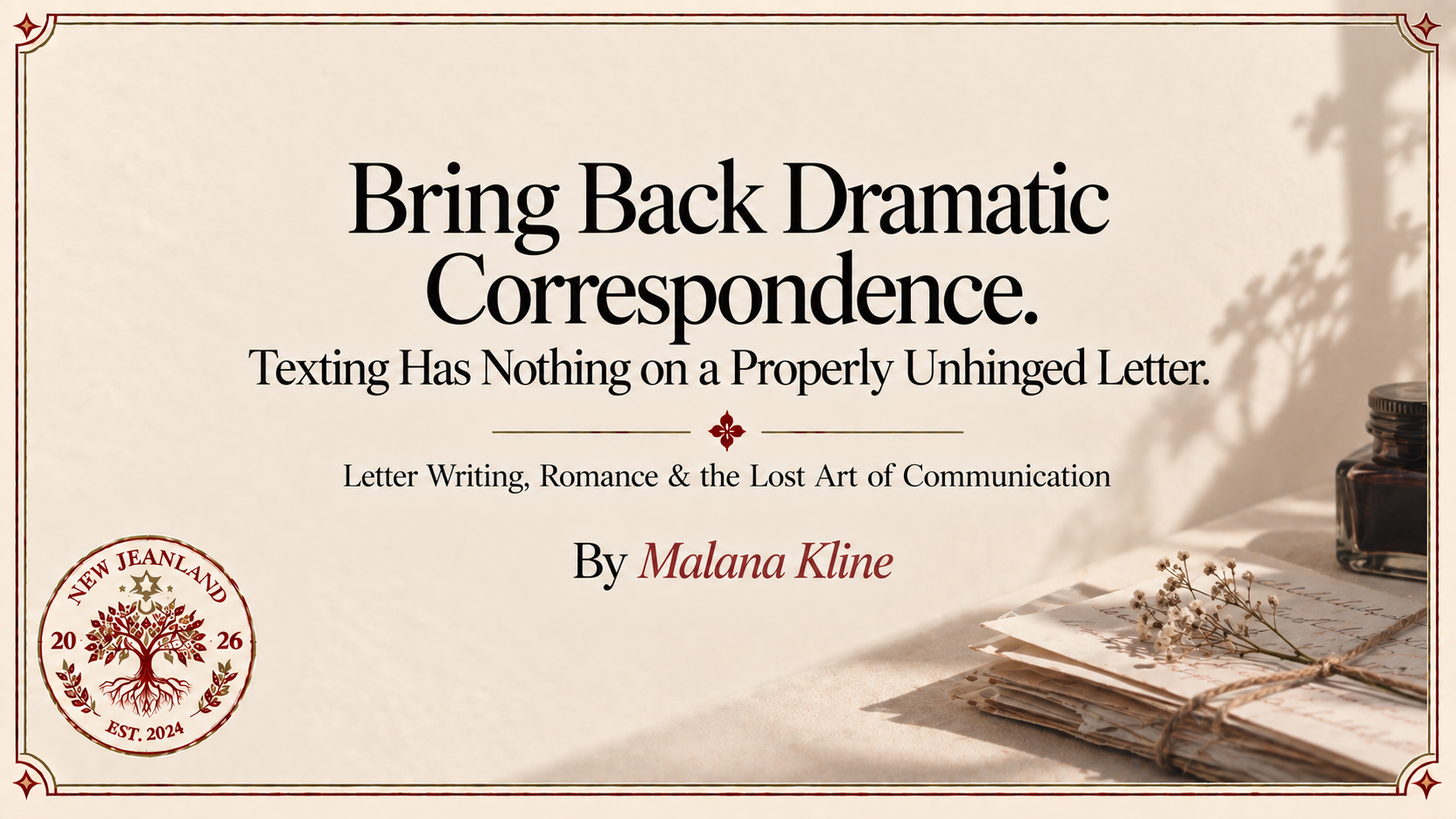
We traded declarations, confessions, and beautifully unnecessary emotional excess for “wyd.” Civilization has suffered enough.
There was a time when people did not simply “check in.” They wrote six pages by candlelight because someone had failed to answer their last letter quickly enough. They crossed out entire paragraphs, reconsidered their dignity, put the dignity back in, sealed the envelope, reopened it, added a postscript, and then spent three days wondering whether the post had been delayed or whether they had ruined their life. This was communication.
Now we have:
“hey”
“you up?”
“lol”
“sorry just saw this”
We have gained speed, certainly. We have not necessarily gained grandeur. I am not suggesting that every conversation needs to arrive on cream stationery with a wax seal and a faint implication of tuberculosis. I am only saying that modern communication has become offensively efficient, and somewhere along the way we lost the pleasure of being a little excessive. Bring back dramatic correspondence.
Texting Is Too Easy
Texting encourages the worst possible version of restraint: not thoughtful restraint, but laziness disguised as casualness.
A thought enters your head. You send it immediately. No composition. No anticipation. No ceremonial suffering. You can tell someone you miss them while standing in line at Walgreens between checking the price of shampoo and opening Instagram.
There is something spiritually inadequate about this.
A letter requires commitment. You have to sit down. You have to decide what you actually mean. You have to keep going after the first sentence instead of sending it and waiting to see how the other person responds. You cannot outsource the emotional direction of the conversation to three dots appearing on a screen.
Once you begin the letter, you are on your own. This is how people end up saying things.
We Used to Have Better Ways to Be Unhinged
One of the great losses of modern communication is the disappearance of respectable emotional excess. Today, if you send someone nine consecutive text messages about your feelings, everyone agrees that something has gone terribly wrong.
Put exactly the same emotional content in a letter, however, and suddenly you have literature. This seems arbitrary, but I support it. A letter allows a person to be intense without looking as though they are experiencing a live systems failure.
You can write: I have tried very hard not to think of you, which has unfortunately required thinking of you almost constantly.
That is correspondence.
Send it as four texts at 1:13 a.m. and your friends are taking your phone away. The medium matters.
A letter gives emotional instability architecture. It puts margins around the problem.
The Waiting Was Part of It
Modern communication has almost completely eliminated suspense.
If someone has not answered your text, you can usually tell whether they have been online. You may know that they watched your story, liked somebody else’s post, and were apparently available to spend seventeen minutes arguing about a television show while remaining mysteriously incapable of responding to you. This is terrible information to possess.
Letters were kinder. You sent something into the world and then had no choice but to develop character. Maybe they had not received it. Maybe the reply was already on its way. Maybe the horse had encountered weather. You simply did not know.
There was room for mystery. Now, the mystery is usually whether someone is ignoring you deliberately or merely with remarkable consistency. Progress has its drawbacks.
A Letter Has Weight
Digital communication is strangely disposable. You can have one of the most important conversations of your life in the same message thread where, three weeks earlier, you sent a photo of a weird vegetable. Declarations of love sit between grocery reminders and links to TikToks. Breakups happen above automated delivery notifications. Entire relationships can be reduced to searchable text.
A physical letter refuses to be quite so casual. Someone touched it. They chose the paper. They wrote your name. Their hand moved across the page. Maybe the ink changed slightly where they paused. Maybe a sentence was crossed out but still visible enough for you to know they almost said something else. The object carries evidence of the person.
A text tells you what someone typed; a letter sometimes tells you how they hesitated.
Handwriting Is Intimate in a Way Fonts Cannot Be
There is something almost indecent about recognizing another person’s handwriting immediately. You know how they make their r. You know whether they press too hard with the pen. You know which letters collapse into each other when they are rushing. It is language with a body attached to it.
Typed words arrive scrubbed clean of those small physical traces. Everyone speaks in the same font.
Handwriting preserves evidence of mood and movement. A hurried letter looks hurried. A careful one looks careful. Anger can become darker on the page. Affection can become unnecessarily elaborate.
Even bad handwriting becomes intimate once you know whose it is. Especially bad handwriting, perhaps. There is something romantic about needing contextual clues to determine whether a person has written “forever” or “ferret.”
We Have Lost the Art of the Postscript
The postscript alone deserves restoration. P.S. was where dignity went to die.
The main letter could be composed, elegant, rational. Then:
P.S. I dreamed about you again.
P.S. Burn this.
P.S. I did not mean what I said in paragraph three.
P.S. Actually, I did.
P.S. Do not write back unless you mean it.
P.S. Please write back.
This is craftsmanship.
A modern text conversation does not have a postscript because it never ends. There is always another message available. Nothing has to be final enough to require one last dangerous thought squeezed beneath the signature.
The postscript existed because the letter had already been concluded and the writer failed, emotionally, to remain concluded. I respect that.
Romance Needs a Little Inconvenience
Efficiency is useful for ordering food. It’s not always useful for romance.
There is something meaningful about effort that serves no practical purpose. Driving across town to see someone for twenty minutes. Keeping a ridiculous little object because they touched it once. Writing three pages when one sentence would technically communicate the necessary information.
Modern life has trained us to eliminate friction wherever possible, but some forms of friction are part of what gives an experience weight.
A love letter is inefficient by design. That is why it matters. You could text “miss you” in four seconds. Instead, you sat at a desk and tried to explain the exact shape of missing someone. Those are not emotionally equivalent acts simply because they communicate approximately the same information.
Not Everything Needs to Be Cool
Possibly the greatest argument for letters is that they make coolness difficult. Our current communication culture places tremendous value on appearing unbothered.
Do not respond too quickly.
Do not say too much.
Do not double text.
Do not reveal that you were waiting.
Do not care visibly until the other person has demonstrated an equal or preferably greater amount of caring.
This is an exhausting amount of strategy devoted to making sure nobody accidentally discovers that human beings have feelings.
Letters are badly suited to this. The very act of writing one admits investment. Nobody accidentally writes four pages. You cannot plausibly claim you “just happened” to find stationery, address an envelope, purchase postage, and compose a meditation on someone’s absence.
You cared. There is the evidence. I think we could use more of that.
Bring Back Beautifully Unnecessary Things
I am not actually proposing the abolition of texting. I enjoy being able to ask someone where they are without waiting six business days for an answer.
Some things deserve more ceremony than a notification.
Write somebody a letter. It does not have to be romantic. Write your best friend and tell them something you have never properly said. Write your mother about a memory she probably forgot. Write someone you love from the next room simply because it would be ridiculous.
Make the handwriting terrible. Use unnecessarily good paper. Add a postscript after you already said everything. Be embarrassingly sincere. Human communication does not always need to be optimized.
Sometimes, it should be slow enough that you have time to realize what you mean. Sometimes, it should leave an object behind. And sometimes, when the feeling is sufficiently dramatic, “thinking of you” simply does not have the range.
You need three pages, a sealed envelope, and at least one sentence you will regret immediately after mailing it.


Leave a Reply