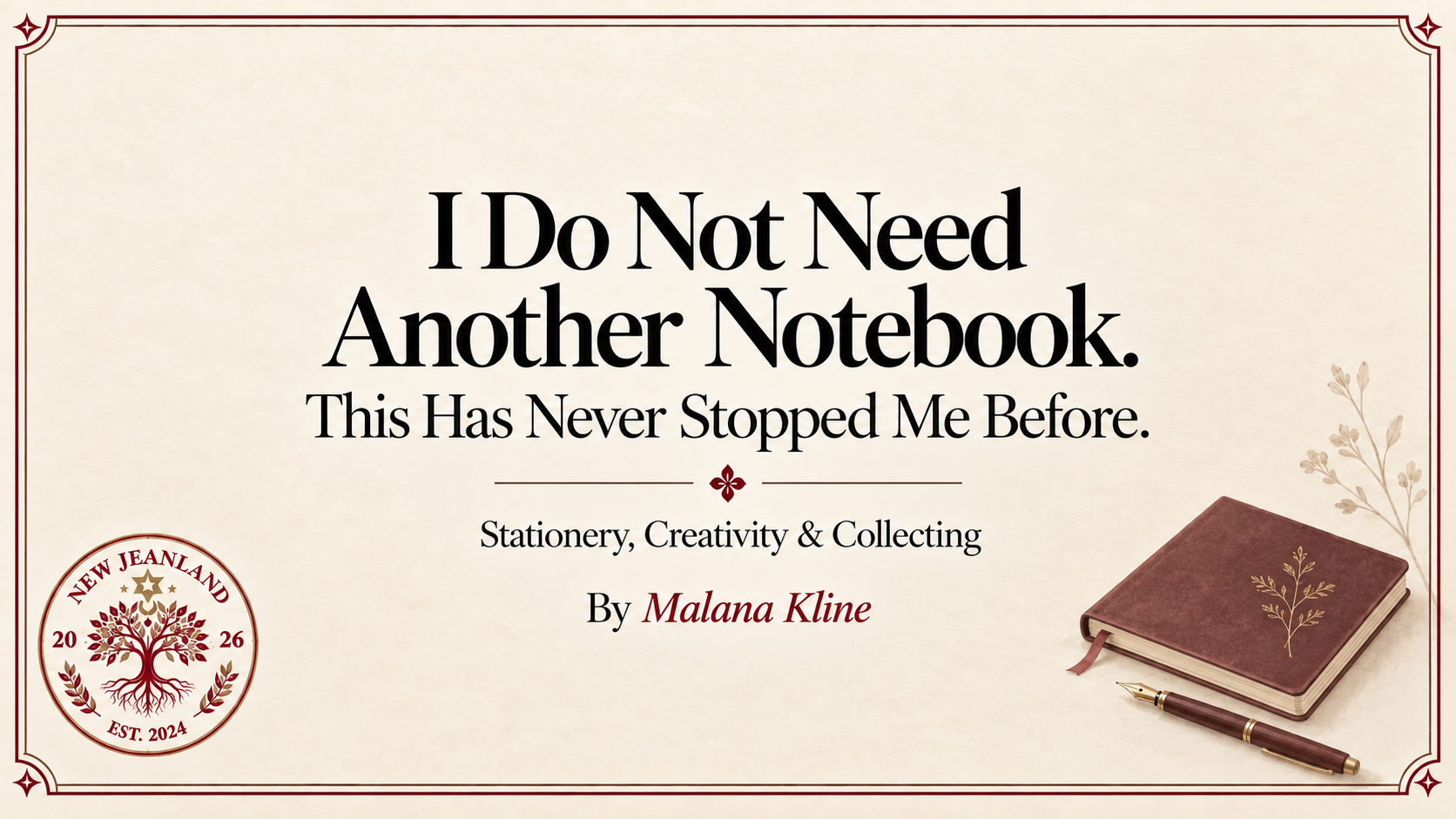
A Completely Reasonable Defense of Buying Office Supplies I Absolutely Do Not Need.
I do not need another notebook. This is an objective fact. I currently own notebooks that are blank, notebooks that are half-filled, notebooks that contain three pages of handwriting from 2012 and nothing else, notebooks purchased for specific purposes I have since forgotten, and notebooks so pretty that using them feels vaguely destructive.
Yet, if I walk past a display of fresh notebooks in a bookstore or office supply aisle, I will stop. Obviously. What if one of them is the notebook? You know the one. The notebook that finally makes me organized. The notebook in which I will maintain neat, consistent records of my ideas. The notebook that will not somehow become an unstable mixture of grocery lists, article titles, phone numbers, half a poem, a password hint, three names I liked for fictional characters, and the words LOOK THIS UP LATER with no indication whatsoever of what “this” was.
That notebook could be sitting right there. It would be irresponsible not to check.
Office Supplies Are Tiny Promises
There is something deeply optimistic about buying stationery because every object arrives carrying a small assumption about the person you are about to become. A fresh notebook assumes there will be thoughts worth writing down. A new pen assumes there will be sentences worth keeping. A package of sticky notes suggests that Future Me will be organized enough to categorize information instead of scribbling it on the back of an envelope and losing it immediately.
Folders imply structure. Highlighters imply scholarship. Paper clips imply that at some point I will possess multiple sheets of paper that belong together and, crucially, recognize this fact in time to clip them.
Office supplies believe in me far more than the available evidence justifies, which may be part of their charm.
Buying a notebook is therefore not exactly buying paper. It is buying a small rectangular possibility. Maybe this one becomes a journal. Maybe it holds a novel. Maybe it becomes the place where I finally develop a system for tracking projects that survives longer than eleven days. Or maybe I write six pages in it, abandon it for eight months, rediscover it in a drawer, and become briefly fascinated by the person who apparently felt compelled to write “fox thing???” in the margin.
All outcomes are valid.
The Notebook Has To Be Right
People who do not collect stationery sometimes make the mistake of believing notebooks are functionally interchangeable. These people have failed to account for the variables.
There is paper weight, page color, binding, line spacing, cover texture, whether the notebook lies flat, and whether the pages are lined, dotted, blank, or arranged in some unnecessarily specific productivity system capable of convincing you that you are about to become the CEO of your own life.
Then there is the question of vibe, which is both impossible to quantify and somehow more important than all the other considerations combined.
A black hardcover notebook is serious. Important things happen in there. A little floral notebook is for thoughts you might have while drinking tea near a window. A leather-bound journal is clearly intended for observations made during sea voyages, regardless of whether you have ever been on a sea voyage. A cheap spiral notebook possesses tremendous creative potential precisely because there is no pressure to respect it.
The beautiful notebook is another matter entirely.
You know the kind: embossed flowers, handmade paper, gold-edged pages, a ribbon marker, perhaps a clasp for reasons no one can adequately explain. You buy it because it is gorgeous, then immediately realize that your ordinary thoughts are not good enough for it. This notebook cannot possibly be wasted on meeting notes, grocery lists, or a paragraph beginning with “possible article idea??”
So you save it until you have something worthy to write inside.
You never do.
It remains blank forever.
This is its destiny.
Pens Are Worse
Notebooks at least occupy enough physical space to remind you that perhaps there should be limits. Pens are more dangerous because technically you can always justify another one.
Maybe this one writes more smoothly. Maybe the ink dries faster. Maybe the tip is 0.5 millimeters instead of 0.7, and apparently that difference has become central to your identity. Maybe it comes in blue-black, which is obviously different from blue and therefore cannot be treated as redundant.
There are gel pens, fountain pens, ballpoints, felt tips, brush pens, fineliners, rollerballs, and pens with ink so dark and satisfying that writing an ordinary grocery list suddenly feels like signing an international treaty.
Every so often you find one that moves across the paper exactly right. The weight is good, the ink behaves, the tip does not scratch, and your handwriting improves by approximately eight percent simply because the pen seems to expect better from you. At that point, you are no longer purchasing pens. You are securing replacements against the possibility that the manufacturer will someday discontinue the model and civilization will collapse shortly afterward.
This is reasonable behavior. I will not be taking questions.
Creativity Likes Props
There is, beneath all this nonsense, a practical reason creative people are drawn to stationery. The objects surrounding a task can become part of the ritual of doing it.
Opening a notebook, choosing a pen, laying out index cards, rearranging sticky notes, or writing something by hand instead of typing it can create a small psychological threshold between thinking about working and actually beginning. None of these objects are necessary. I could write almost everything I need on the computer already sitting in front of me. In fact, I usually do.
But creative work has always accumulated rituals. Writers have favorite pens. Artists become attached to particular sketchbooks. Students develop emotional relationships with specific highlighters that would be difficult to defend under oath. Some people can sit down anywhere, open a laptop, and immediately begin working. Others apparently require a carefully assembled nest of beverages, notebooks, chargers, reference materials, and approximately seventeen writing instruments before a single useful thought can occur.
I know which category I belong to.
The supplies do not create the idea, but sometimes they create enough anticipation that you want to begin. That matters more than it sounds. Starting is often the least glamorous and most difficult part of making anything, and if an unnecessarily nice notebook gets you across that threshold, perhaps the notebook has earned its keep.
Or at least enough of its keep that we do not need to discuss the other twelve.
There Are Worse Things to Collect
At some point, a reasonable person might suggest using the notebooks already in my possession before purchasing additional notebooks. I understand this argument conceptually. It has logic behind it. I simply do not see why logic should be granted unilateral authority over the office supply aisle.
Stationery is, after all, one of those small and relatively harmless pleasures that makes ordinary life more pleasant. There is satisfaction in opening a drawer and seeing rows of pens. There is delight in discovering a notebook with unusually good paper. A fresh pad of sticky notes can produce an amount of happiness wildly disproportionate to both its price and its practical importance.
Human beings have collected decorative objects for thousands of years. Mine just happen to come with ruled pages and occasionally serve a purpose.
Occasionally, I even use them. Which makes the whole thing practically responsible.
So no, I do not need another notebook. I know this. You know this. Somewhere beneath its tasteful linen cover, even the notebook probably knows this. But the paper is unusually thick, there is a little pocket in the back, and it lies completely flat when opened.
Be serious. What was I supposed to do?




Leave a Reply